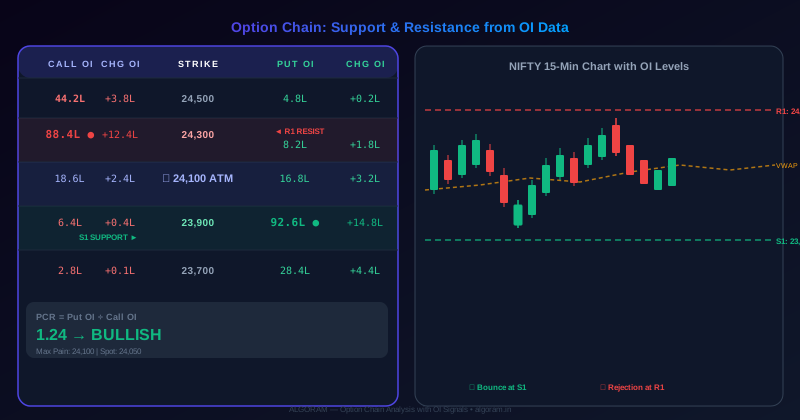
What Is an Option Chain?
An option chain is a comprehensive table showing all available option contracts for a specific underlying asset — Nifty 50, Bank Nifty, or a stock — across multiple strike prices for a given expiry date. Each row represents one strike price, and the table shows the data for both Call options (on one side) and Put options (on the other side).
The columns you'll typically see on the NSE option chain include: Open Interest (OI), Change in OI, Volume, Implied Volatility (IV), LTP (Last Traded Price), Bid, Ask — all for both Calls and Puts at each strike price.
For traders who analyse support and resistance, the most important columns are OI (Open Interest) and Change in OI. Everything else is secondary confirmation.
Traditional support and resistance is based on historical price levels — where price reversed in the past. Option chain support and resistance is based on current market positioning — where institutional traders and large option writers have placed their money right now. This makes it a leading indicator rather than a lagging one.
Understanding Call OI and Put OI
What is Open Interest (OI)?
Open Interest is the total number of outstanding option contracts that have not been settled. Every options contract involves a buyer and a writer (seller). When both open a new position, OI increases by 1. When either side closes their position, OI decreases by 1.
Key principle: High OI at a strike means more money is concentrated at that level. This concentration acts as a gravitational force on price — both attracting it (to cause maximum pain to buyers) and repelling it (when writers defend their position).
Call Open Interest — The Resistance Signal
Call OI represents positions where option writers have sold Call options at specific strike prices. A Call writer profits when the market stays below the strike at expiry. Therefore, a strike with very high Call OI tells you: large institutional sellers expect the market to stay below this level.
This creates resistance — not just because of technical analysis, but because Call writers will actively hedge their positions (by shorting the underlying or buying Put spreads) if price approaches their strike. This institutional activity creates real selling pressure at the resistance level.
Put Open Interest — The Support Signal
Put OI represents positions where option writers have sold Put options at specific strike prices. A Put writer profits when the market stays above the strike at expiry. Therefore, a strike with very high Put OI tells you: large institutional sellers expect the market to stay above this level.
This creates support. Put writers will hedge by buying the underlying if price falls toward their strike — generating real buying pressure at the support level.
Support and Resistance in the Options Market
Option Chain Support vs Traditional Chart Support
| Factor | Option Chain Support/Resistance | Traditional Chart S&R |
|---|---|---|
| Based on | Current OI positioning (live data) | Historical price reversals |
| Type | Leading indicator | Lagging indicator |
| Driven by | Institutional option writers | Past buyer/seller behavior |
| Updates | Every 5 minutes (live) | Static until price revisits |
| Strength signal | OI Change confirms fresh writing | Number of touches |
| Most reliable | Expiry week, range-bound markets | Strong trending markets |
| Weakens when | Strong trend overruns writing | Levels break on high volume |
Step-by-Step: How to Identify Support and Resistance Using Option Chain
Open the Option Chain
Go to nseindia.com → Market Data → Option Chain (or your broker's platform). Select the underlying: Nifty 50, Bank Nifty, or a stock. Choose the nearest weekly or monthly expiry. You now see all strikes with Call and Put data side by side.
Identify ATM (At The Money) Strike
Find the current spot price of the index and identify the ATM strike (closest to current price). This is your reference point. Strikes above ATM are where you look for Call OI (resistance). Strikes below ATM are where you look for Put OI (support).
Find the Highest Put OI Strike (Support)
Scan the Put OI column for strikes below ATM. Find the strike with the single largest Put OI value. This is your primary support. Typically, the top 2–3 Put OI strikes in order of magnitude are your support 1, support 2, support 3. Write them down before market opens.
Find the Highest Call OI Strike (Resistance)
Scan the Call OI column for strikes above ATM. Find the strike with the single largest Call OI value. This is your primary resistance. The top 2–3 Call OI strikes in order of magnitude are R1, R2, R3.
Confirm with OI Change
Check the Change in OI column for your identified strikes. Positive OI Change = fresh positions added (level strengthening — more conviction). Negative OI Change = positions being closed (unwinding — level weakening, may not hold). Only trade against levels where OI is rising.
Calculate PCR
Add up total Put OI across all strikes. Divide by total Call OI. PCR = Total Put OI ÷ Total Call OI. Above 1.2 = bullish market sentiment (heavy Put writing = support strong). Below 0.8 = bearish (heavy Call writing = resistance strong). Between 0.8 and 1.2 = neutral, range-bound expected.
Find Maximum Pain Level
Identify the strike where total value of all outstanding options (both Call and Put combined) is minimised. This is the Max Pain level. As expiry approaches, the market tends to gravitate toward this level. Treat it as a magnetic target for expiry-day analysis.
Live Option Chain Example — Nifty (Illustrative)
Below is a simplified, illustrative option chain snapshot. Real data refreshes every 5 minutes on NSE's website. This structure mirrors what you'd see on any trading platform:
| ← CALLS | STRIKE | PUTS → | ||||||
|---|---|---|---|---|---|---|---|---|
| OI | Chg OI | Vol | LTP | OI | Chg OI | Vol | LTP | |
| 44,20,000 | +3,80,000 | 12,400 | 15.50 | 24,500 | 4,80,000 | +20,000 | 1,800 | 145.60 |
| 🔴 88,40,000 | +12,40,000 | 38,200 | 8.20 | 24,300 ◄ R1 | 8,20,000 | +1,80,000 | 4,200 | 98.40 |
| 18,60,000 | +2,40,000 | 52,800 | 42.80 | ⭐ 24,100 ATM | 16,80,000 | +3,20,000 | 48,400 | 38.60 |
| 6,40,000 | +40,000 | 8,400 | 95.20 | 23,900 ◄ S1 | 🟢 92,60,000 | +14,80,000 | 42,600 | 14.80 |
| 2,80,000 | +10,000 | 2,800 | 148.60 | 23,700 ◄ S2 | 28,40,000 | +4,40,000 | 12,800 | 8.20 |
🔴 R1 = 24,300: Highest Call OI (88.4 lakh) with strong fresh writing (+12.4 lakh OI Change) = very strong resistance. Market needs to absorb all this Call writing to break above.
🟢 S1 = 23,900: Highest Put OI (92.6 lakh) with strong fresh writing (+14.8 lakh OI Change) = very strong support. Put writers will defend this level aggressively.
ATM = 24,100: Nifty is currently range-bound between S1 (23,900) and R1 (24,300). Trade within range until either OI level breaks or gets unwound.
PCR — Put Call Ratio
The Put Call Ratio is one of the simplest yet most powerful sentiment indicators derived from option chain data.
PCR = Total Put OI ÷ Total Call OI
Important nuance: PCR is a contrarian indicator at extremes. PCR above 1.5 = excessive Put buying = market may be oversold and due for bounce. PCR below 0.5 = excessive Call buying = market may be overbought and due for pullback. Professional traders use these extremes as reversal signals rather than continuation.
Maximum Pain Theory
Maximum Pain (also called Max Pain) is the strike price at which the total dollar value of outstanding options — both Calls and Puts — would expire worthless if the market closed there at expiry.
From the perspective of option writers (who hold the opposite side of all those contracts), Max Pain is the price at which they collectively profit the most. Because option writers tend to be large institutions with the ability to hedge their books through futures positions, there is a measurable tendency for the market to gravitate toward Max Pain as expiry approaches.
1. Max Pain is most effective in the last 2–3 days before expiry — earlier in the week, it has less influence.
2. If market is trading above Max Pain, expect gradual drift downward toward Max Pain as expiry nears.
3. If market is trading below Max Pain, expect support and gradual upward drift toward Max Pain.
4. Strong fundamental/macro events can override Max Pain mechanics entirely.
5. Calculate Max Pain fresh each morning — it shifts daily as OI changes.
OI Build-up vs Unwinding — The Critical Distinction
| Pattern | Price | OI | Interpretation | Trade Implication |
|---|---|---|---|---|
| Long Build-up | Rising | Rising | Fresh longs added — buyers entering | Bullish momentum |
| Short Build-up | Falling | Rising | Fresh shorts added — sellers entering | Bearish momentum |
| Short Covering | Rising | Falling | Shorts exiting — OI falls on rally | Rally may lose steam |
| Long Unwinding | Falling | Falling | Longs exiting — OI falls on decline | Fall may lose momentum |
| Call Writing (Resistance) | Near/below strike | Call OI rising | Writers adding resistance | Sell CE, trade below strike |
| Put Writing (Support) | Near/above strike | Put OI rising | Writers adding support | Buy CE at support bounce |
| Call Unwinding | Rising fast | Call OI falling | Resistance weakening — breakout possible | Breakout signal — buy CE |
| Put Unwinding | Falling fast | Put OI falling | Support giving way | Breakdown signal — buy PE |
Intraday Option Chain Analysis
For intraday traders, option chain provides the daily trading range before the market opens. Here's the practical intraday workflow:
- Pre-market (8:45–9:10 AM): Open NSE option chain for the nearest weekly expiry. Note the highest Put OI strike (S1) and highest Call OI strike (R1). These define your intraday range.
- 9:15–9:30 AM — Opening range: Watch whether price opens within S1–R1 range (range-bound day expected) or gaps outside (breakout setup). If gap outside range, check if Call/Put OI is being unwound (genuine breakout) or still rising (fake breakout, fade the move).
- Intraday refreshes: Refresh option chain every 15–30 minutes. Significant OI shifts (sudden surge at a new strike) indicate institutional positioning — adjust S/R accordingly.
- 2:00–3:30 PM expiry risk: On expiry day, option writers aggressively defend their strikes in the last 30 minutes. Max Pain mechanics are strongest — be cautious with open positions near major OI strikes.
Swing and Positional Option Chain Analysis
For swing traders holding positions 3–10 days, the monthly expiry option chain provides better support and resistance than weekly (more OI concentration, less noise from weekly rollovers).
Key principles for swing analysis: The highest Call OI on monthly expiry is the market's ceiling for the month. The highest Put OI is the floor. Monthly PCR above 1.2 for several consecutive sessions = healthy bullish trend. Monthly PCR declining below 1.0 = distribution phase, consider reducing long exposure.
Insert screenshot: Bank Nifty monthly option chain with highest Call OI (resistance) and Put OI (support) plotted on price chart. Show how price respected these levels over a 2-week period.
Combining Option Chain with Price Action and VWAP
Option chain identifies where the significant levels are. Price action and VWAP tell you how the market is respecting them. The highest-conviction trades occur when all three align:
For a Support Trade:
✓ Highest Put OI strike (S1) identified from option chain
✓ Price approaches S1 and forms bullish candle pattern (hammer, engulfing)
✓ VWAP is above S1 (market respecting VWAP support)
✓ OI Change at S1 is positive (fresh Put writing confirming defense)
Entry: Buy CE above S1 | Stop: Below S1 | Target: R1
When price breaks above R1 but Call OI is still rising (not unwinding) → This is a trap. Call writers haven't exited — they're adding more. The breakout has no institutional confirmation. It will likely reverse. Fade the breakout, or wait for Call OI to fall (unwinding) before going long.
Nifty Option Chain Analysis — Real Market Scenario
Scenario: Nifty is at 24,050. Pre-market option chain check shows:
- Highest Call OI: 24,300 (88 lakh contracts, OI Change +12 lakh) → Strong resistance at 24,300
- Highest Put OI: 23,800 (76 lakh contracts, OI Change +8 lakh) → Strong support at 23,800
- PCR: 1.18 (slightly bullish — more Put writing than Call writing)
- Max Pain: 24,100 (market slightly below max pain = mild upward pull)
Analysis: Market is in a 23,800–24,300 range with bullish bias (PCR 1.18 + Max Pain above spot). Trading plan: Buy CE on dips to 23,800–23,850 area. Exit/short around 24,250–24,300. Reassess if either OI level gets unwound significantly (which would indicate the range is about to break).
Insert screenshot: Nifty 15-min chart showing 23,800 support (Put OI level) and 24,300 resistance (Call OI level) with price bouncing between them. Mark the two option chain S/R levels as horizontal lines.
Bank Nifty Option Chain Analysis
Bank Nifty has weekly Thursday expiry with the highest liquidity among all Indian index options. This makes its option chain especially useful for intraday analysis.
Bank Nifty specifics: BN moves 2–3x more than Nifty, so OI levels can be breached more violently. Always look for OI change confirmation before assuming a level will hold. The biggest PCR extremes in BN (above 1.5 or below 0.6) often signal same-day reversals rather than trend continuation.
Best BN setup: Thursday expiry, 11:00 AM. Check option chain for highest Put OI and Call OI 200–400 points away from spot. If both sides have heavy OI and PCR is 0.9–1.1, range-bound day — sell straddle/strangle. If one side has 3x OI vs other, directional bias exists — trade accordingly.
Breakout Confirmation vs Fake Breakout Detection
| Signal | Genuine Breakout | Fake Breakout |
|---|---|---|
| Price action | Closes above resistance on high volume | Spikes above then pulls back |
| Call OI at resistance | Falling (Call writers unwinding — they're wrong) | Still rising (writers adding to bet) |
| Put OI at previous support | Rising (new support being written above old resistance) | Flat or declining |
| PCR | Rising above 1.0 on breakout | Declining or flat |
| Volume | Significantly above average | Average or below average |
| IV | Drops on genuine breakout | Spikes (uncertainty) |
| Action | Enter long on retest of breakout level | Fade the move (short or buy PE) |
All Comparison Tables
Strong Support vs Weak Support
| Criteria | Strong Support | Weak Support |
|---|---|---|
| Put OI | Very high (top 1–2 strikes by OI) | Moderate (not top OI strike) |
| OI Change | Strongly positive (fresh Put writing) | Flat or slightly positive |
| Volume | High Put volume at strike | Low to moderate volume |
| PCR | Above 1.2 overall | Neutral 0.8–1.2 |
| Max Pain | Below current price (upward pull) | Above current price |
| Price action | Multiple bounces from level | First test of level |
| Trade conviction | High — aggressive long entry | Low — smaller size, wider stop |
Intraday vs Swing Option Chain Analysis
| Factor | Intraday Analysis | Swing / Positional Analysis |
|---|---|---|
| Expiry used | Nearest weekly expiry | Monthly expiry (more OI) |
| Refresh frequency | Every 15–30 minutes | Once daily (pre-market + EOD) |
| Key levels | S1/R1 within 200–400 pts of spot | S/R within 500–1000 pts of spot |
| Max Pain relevance | Expiry day only (high impact) | Last week of expiry cycle |
| PCR interpretation | Intraday sentiment shifts matter | Trend over multiple sessions |
| Combining with | VWAP, 5/15-min price action | Daily chart, weekly price action |
| Stop loss logic | Below S1/above R1 option levels | Below prior weekly Put OI level |
Common Beginner Mistakes While Reading Option Chain
- Trading support/resistance from option chain without price action confirmation. OI levels indicate where pressure exists — not guaranteed reversals. Always wait for price action confirmation before entering.
- Ignoring OI Change and only looking at absolute OI. A strike with high OI but falling OI Change is being unwound — the support/resistance is weakening, not strengthening. OI Change is as important as OI itself.
- Using weekly option chain for swing trades. Weekly expiry data is noisy and changes quickly. For positions held 3+ days, use monthly expiry option chain which has more stable, meaningful OI concentrations.
- Assuming Max Pain always works. Max Pain is a tendency, not a guarantee. Strong fundamental triggers (RBI policy, global events, earnings surprises) routinely override Max Pain mechanics.
- Overcomplicating the analysis. The highest Put OI and highest Call OI strikes are often all you need. Beginners sometimes over-analyse every strike instead of focusing on the top 2–3 by OI on each side.
- Ignoring IV (Implied Volatility) changes. Rising IV while price stays flat means options are getting expensive — uncertainty is increasing. Directional trades are riskier in this environment.
- Not accounting for expiry day dynamics. On expiry day (Thursday for BN, last Thursday of month for Nifty), normal rules change. Gamma and Max Pain mechanics dominate. Levels can be hit and reverse quickly. Be especially careful with open positions.
Daily Option Chain Analysis Checklist
Automating Option Chain Analysis — How ALGORAM's OI Signals Work
Manually refreshing the option chain every 15–30 minutes and recalculating PCR, OI changes, and support/resistance levels during live market hours is error-prone and time-consuming. For traders who want to act on this data without spending their entire day in front of an option chain table, automation offers a meaningful advantage.
ALGORAM's platform integrates OI & Volume-Based Signals as an input layer into its automated strategy engine. Rather than manually identifying whether the highest Put OI level is strengthening or weakening, the system processes this data continuously and evaluates it against other signal criteria before generating trade signals.
The practical benefit is removing the data processing burden from the trader. Instead of manually noting that the 23,900 Put OI has added 14 lakh fresh contracts this morning and deciding whether that changes your entry criteria, the algorithm does this evaluation on every potential entry — and only executes when the defined combination of OI confirmation, price action alignment, and risk-reward criteria are all satisfied.
For options traders who want to combine their understanding of option chain mechanics with systematic, rule-based execution — and do so without writing any code — ALGORAM's no-code interface lets you define option chain criteria as part of a multi-factor strategy. The Option Chain Analysis and OI & Volume-Based Signals features are available across all ALGORAM plans, with the demo mode allowing traders to test these setups on real NSE live data for 7 days at no cost.
Read more: Top Benefits of No-Code Algo Trading Platforms and How Automated Entry & Exit Improves Trade Execution
📊 Trade Option Chain Signals Automatically
ALGORAM's OI & Volume-based signals auto-confirm support and resistance. 7-day free demo — real NSE data, no code required.
🚀 Launch Offer — First 100 Customers
Conclusion
Option chain analysis transforms support and resistance from a backward-looking concept (based on historical price action) into a forward-looking one (based on where institutional money is positioned right now). The strike with the highest Put OI is where Put writers are defending — creating real buying pressure. The strike with the highest Call OI is where Call writers are capping the market — creating real selling pressure.
The most reliable trades in option chain analysis occur when these OI-based levels align with price action patterns, VWAP holds, and OI Change confirms fresh writing at the level rather than unwinding. PCR and Max Pain add directional bias and expiry-day targets.
Like all technical tools, option chain is most powerful as a confluence element — not a standalone signal. Used alongside price action and volume analysis, it provides a dimension of market insight that purely chart-based analysis cannot offer: the actual positioning of institutional traders in real time.
Practice: → Open NSE option chain tomorrow pre-market. Note S1 and R1 from highest Put/Call OI.
Automate OI signals: → ALGORAM 7-day free demo
Risk management: → Top 10 Trading Mistakes to Avoid
Strategy guide: → Top 10 Algo Trading Strategies
Algo trading basics: → What is Algo Trading? Complete Guide
Frequently Asked Questions

Ankit has used option chain analysis as a primary trading tool for 12+ years across Nifty and Bank Nifty options. He built ALGORAM's OI & Volume-Based Signal layer specifically to automate the daily option chain analysis workflow that most traders spend 30–45 minutes doing manually each morning — making institutional-grade analysis accessible to every retail trader.