Introduction
Most traders don't lose because of bad strategies. They lose because of bad habits.
This is the uncomfortable truth that most trading education avoids. There are thousands of traders in India with sound strategy frameworks — correct understanding of ORB breakouts, RSI reversals, Bank Nifty options flow — who consistently lose money. And there are traders with simpler, less sophisticated approaches who consistently make money. The difference is rarely the strategy. It's the behavior.
SEBI's data on F&O traders is stark: over 90% lose money across any 3-year period. The primary causes cited are not "wrong strategy" — they are inconsistent execution, emotional decisions, inadequate risk management, and behavioral patterns that destroy the edge of otherwise sound approaches.
This article covers the 10 most common and most costly of these behavioral mistakes — what they are, why they happen, what they cost, and exactly how to fix them.
The Real Reason Most Traders Lose Money
Before examining individual mistakes, it's worth understanding the underlying pattern. Most retail traders approach trading as if the primary problem is information — finding the right indicator, the right setup, the right strategy. They spend months learning technical analysis, backtesting patterns, watching YouTube videos.
What they don't spend months on is execution. Consistent, rule-based, emotion-free execution. And that's what actually determines outcomes.
"Every losing month I've had in 15 years of trading had one thing in common: I deviated from my plan. The plan wasn't wrong. The execution was."
— Ankit Patel, Founder & MD, ALGORAMFour behavioral patterns account for most retail trader losses:
- Lack of discipline: Following rules only when convenient, abandoning them under pressure
- Emotional decisions: Fear, greed, and hope overriding defined strategy rules in real-time
- Poor risk management: Position sizes driven by conviction rather than capital-percentage rules
- Inconsistent execution: Same strategy producing wildly different results because of inconsistent implementation
Every mistake in this article is a specific manifestation of one or more of these four patterns. Understanding the root cause matters — because it points toward the most effective solution.
The 10 Biggest Trading Mistakes
Overtrading means executing trades outside your defined setup criteria. A trader whose strategy signals 3–5 high-quality setups per day instead takes 15–20 trades because of boredom, the desire to "be in the action," or the compulsion to recover losses through volume.
The math is brutal. If your strategy has a genuine edge on its defined setups, every additional trade outside those criteria is statistical noise. If you have 5 quality setups at 65% win rate and add 10 low-quality trades at 45% win rate, your overall account performance deteriorates even if the original 5 remain profitable. The quality trades' gains are diluted by the volume trades' losses — plus transaction costs on every additional order.
Real scenario: Rohit's ORB strategy on NIFTY defines entry only when price breaks the opening range with 3x average volume in the first 15 minutes. The signal fires twice per week on average. On days when no signal fires, Rohit "improvises" entries based on gut feel — taking 3–4 extra trades. His strategy's edge is 0.8% per week. His improvised trades average -0.4% per week. Net result: marginal performance despite a strong underlying strategy.
Define your setups precisely and trade only those. ALGORAM's automated engine only executes when all defined signal conditions are met — no improvisation possible. Daily Loss Limit Auto Stop also prevents the "need to recover" trades that drive most overtrading after a loss.
A stop loss is not a suggestion. It is the line between a bad trade and an account-destroying event. Without a stop loss, there is no defined maximum loss on any trade. A position can move against you 5%, 20%, 50% — and if you don't exit, it keeps going.
The mathematics of recovery make this concrete: a 10% loss requires an 11.1% gain to recover. A 25% loss requires a 33% gain. A 50% loss requires a 100% gain. Without stop losses, one catastrophic trade can require months of profitable trading just to return to breakeven — before any growth is possible.
Most traders know they should use stop losses. They set them before entering. Then they "just let it breathe a little longer." Then they hope. Then they average down. This psychological pattern — the inability to accept a small, defined loss — is the direct cause of most catastrophic account drawdowns in retail trading.
Make stop loss placement non-negotiable — and automate it. ALGORAM places a stop loss simultaneously with every entry order. The trader cannot override it in the moment of emotional pressure. ALGORAM's Trailing Stop Loss also locks in profit automatically as a trade moves in your favour — so exits improve over time without manual intervention.
Revenge trading is what happens in the 30 minutes after a significant loss. The trader, experiencing a mix of frustration, embarrassment, and financial anxiety, immediately enters another trade — usually with a larger position — driven not by strategy but by the emotional need to "get it back."
Every element of this behavior is catastrophically wrong. The trade is entered under maximum emotional distress, which is the worst possible condition for decision-making. It usually doesn't meet the trader's own setup criteria. The position size is larger than normal, meaning a loss hurts more. And it compounds the psychological damage of the original loss.
Revenge trading is identifiable by a specific pattern in account statements: the worst days of the month consistently occur 15–30 minutes after the first significant loss of that day.
Remove the ability to revenge trade. ALGORAM's Daily Loss Limit Auto Stop automatically halts all trading when cumulative daily losses hit your pre-set threshold. After a bad trade, the system simply stops — it cannot be overridden emotionally. The revenge trade never happens because the platform has already ended the day's trading session.
FOMO entries happen when a trader sees a stock or index moving strongly and enters because they fear missing the continuation — without waiting for their defined entry signal, and often significantly after the ideal entry price has passed.
The problem is structural. A FOMO entry typically occurs at a price 15–30% above where the original signal fired. The risk-reward ratio is now terrible — the stop loss (originally defined at the signal level) is now far below, meaning maximum risk is much higher. The probability of the trade working has also decreased because the easy move has already happened. And because the entry feels "late," the trader is psychologically primed to exit even faster at the first sign of weakness.
FOMO is particularly destructive in options trading, where premium decay and bid-ask spreads make late entries even more costly.
Define your entry exactly and only enter there. ALGORAM's automated system enters only at the defined signal price level — it doesn't chase. If the signal fires at ₹142 CE and the premium has already moved to ₹168 by the time a manual trader notices, ALGORAM either entered at ₹142 (if the signal was defined properly) or skips the trade. No FOMO possible.
Professional traders risk 0.5–2% of total capital per trade. Most retail traders risk 10–30% per trade, driven by confidence level rather than capital-management rules. This single difference explains a large part of the performance gap between professionals and retail traders.
At 1% risk per trade: 50 consecutive losses wipe out 40% of capital (survivable — strategy still has runway to prove itself). At 10% risk per trade: 7 consecutive losses wipe out 52% of capital. At 30%: 3 losses wipe out 66%. Most strategies will have 5–10 consecutive losses at some point. The difference between surviving this drawdown and blowing your account is entirely position sizing.
The compounding effect works the same way in reverse. At 1% risk with a 2:1 reward, 10 wins in a row grows capital by 18.7%. At 30% risk, 3 wins grow capital by 197% — but the variance is catastrophic and unsustainable.
Define maximum risk per trade as a capital percentage, not a rupee amount. ALGORAM's Smart Capital Allocation and Risk Control Per Trade enforce position sizes mathematically from your capital allocation settings — never from conviction level. Every trade has the same system-defined maximum risk regardless of how "strong" the signal appears.
Every strategy has a "best environment." Trend-following strategies work exceptionally well in trending markets and get chopped apart in sideways, low-volatility conditions. Mean-reversion strategies work in range-bound markets and get destroyed in strong trends. Breakout strategies need volatility. Momentum strategies need directional conviction in the broader market.
Most retail traders use one strategy regardless of market conditions. In the strategy's ideal environment, it works. In the wrong environment, it loses money consistently — and the trader interprets this as "the strategy is broken" rather than "the strategy needs the right conditions." They either abandon a good strategy prematurely or persist in an environment where it structurally cannot work.
Match strategy to market regime. ALGORAM's Auto Strategy Switch detects current market regime (trending, sideways, volatile) and activates the appropriate strategy automatically. The Multi-Strategy Engine can run different strategies for different market conditions in parallel — so performance is maintained across changing environments without manual reconfiguration.
A trading plan defines exactly what you will do before the market opens — not during it. Every decision made under live market pressure is made under cognitive load, time pressure, and emotional interference. Every decision made in advance, calmly, with full information, is made under ideal conditions.
Traders without a plan are making critical decisions (entry, exit, stop loss, position size) in the worst possible cognitive environment. Predictably, they perform worse than their strategy's theoretical potential in almost every case.
A trading plan doesn't need to be complex. A complete plan includes: entry criteria (specific, measurable), exit criteria (both profit and stop loss), maximum position size per trade, maximum daily loss, and conditions under which you will not trade (e.g., major news events, VIX above threshold, gap opens).
Build your plan once, configure ALGORAM once, and let the system execute it every session identically. The "plan" is built into the platform's settings: entry rules, exit rules, stop loss, daily limit, capital allocation. It executes your plan without deviation — not because of discipline, but because it doesn't have the option to deviate.
Many retail traders look only at price charts — ignoring data that institutional traders treat as primary inputs. Open Interest (OI) data at the strike level tells you where big money has positioned itself. Volume confirms whether institutional participation is behind a price move. Put-Call Ratio indicates the market's directional bias. VIX levels indicate whether options premiums are cheap or expensive relative to historical volatility.
Entering a NIFTY CE position without checking OI data is like driving while ignoring road signs. You might get where you're going, but you're missing critical information that would change many of your decisions.
ALGORAM's built-in Option Chain Analysis and OI & Volume-Based Signals evaluate market microstructure data before every trade. Entries are confirmed against OI direction, volume anomalies, and institutional flow signals automatically. The AI layer processes these signals in milliseconds — data that would take a manual trader several minutes to review for each potential setup.
Every trader knows emotions affect decisions. Very few understand the specific mechanics of how each emotion causes specific, predictable errors:
- Fear causes premature exits on winning trades — taking ₹500 profit because you're afraid of losing it, when the target was ₹1,500
- Greed causes holding losing positions past the stop — "it'll come back" — until small losses become large ones
- Hope is what greed becomes after the stop loss has been breached — continuing to hold and hope for recovery instead of exiting
- Panic causes selling at precisely the worst moments — the flash dip that immediately reverses, turning a temporary drawdown into a locked-in loss
These aren't personal weaknesses — they are documented psychological phenomena that affect every human under financial pressure. Research consistently shows that even professional traders with years of experience make systematically worse decisions in real-time high-stakes environments compared to their pre-market analysis.
Automation doesn't experience any of these emotions. ALGORAM's Emotion-Free Trading executes the same logic on its 500th trade as on its first — regardless of what happened in the previous 499. Exits happen at targets, not at wherever fear says to exit. Stops trigger at the defined level, not where hope says "just a bit longer." For more: Manual vs Automated Trading: The Execution Gap
A trader who doesn't systematically review performance has no way to distinguish between "my strategy has an edge" and "I've been getting lucky." They can't identify which types of setups work and which don't. They can't see whether their execution is adding or subtracting from theoretical performance. And they can't catch behavioral patterns — like the fact that their Monday morning trades are consistently worse than their Tuesday afternoon trades.
Performance review doesn't need to be complex. A weekly 20-minute review covering: number of trades taken vs signals fired (overtrading check), win rate vs expected win rate, average win vs average loss, and whether exits matched plan (early exits, late exits) — catches 90% of behavioral issues before they become patterns.
ALGORAM's Backtesting + Live Performance Tracking logs every trade with full attribution — entry price, exit price, signal type, P&L, and comparison to expected performance. Weekly review is built into the dashboard. Deviations between live performance and backtested expected performance highlight execution issues automatically. Related: Why Traders Are Switching to AI-Based Trading
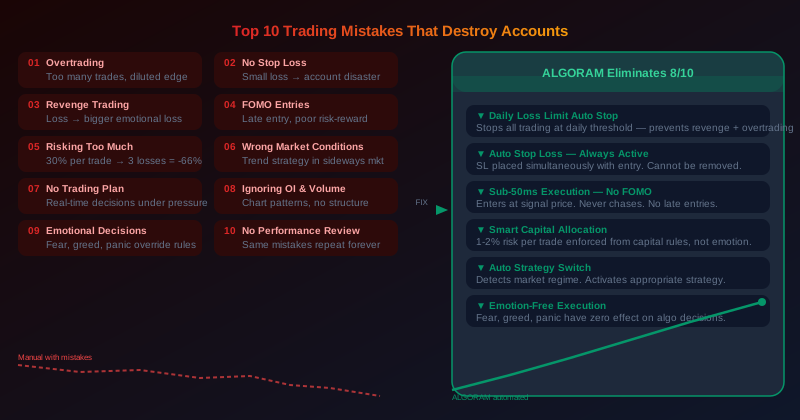
🤖 Eliminate These Mistakes with Automation
ALGORAM's system addresses 8 of these 10 mistakes at the platform level. 7-day paper trading demo on real NSE data — zero financial risk.
Winning Traders vs Losing Traders
| Factor | ✅ Winning Traders | ❌ Losing Traders |
|---|---|---|
| Risk Management | 1–2% max per trade, always | 10–30% based on confidence |
| Stop Loss | Pre-defined, never moved against position | Optional, frequently skipped or moved |
| Trading Plan | Specific, written, followed consistently | Vague or nonexistent |
| Emotional Control | System-enforced or highly disciplined | Decisions driven by real-time emotion |
| Overtrading | Trade only defined setups | Trade from boredom or FOMO |
| Revenge Trading | Daily limit prevents it | Regular occurrence after losses |
| Performance Review | Weekly systematic review | Rarely reviewed, patterns unrecognised |
| Strategy Testing | Backtested on historical data before live | Used live without validation |
| Market Conditions | Strategy matched to current regime | Same strategy in all conditions |
| Data Usage | OI, Volume, PCR confirmed | Chart patterns only |
How Automation Prevents These Mistakes
Of the 10 mistakes in this article, 8 are behavioral — they happen because of how humans respond to financial pressure in real time. Automation removes the human from the moment of execution and eliminates these behavioral failure points.
Prevents revenge trading and overtrading after losses by automatically stopping all trading when the daily threshold is hit. The spiral of bad days becoming catastrophic days ends here.
Entries happen at the defined signal price in 50ms — no FOMO, no late entries. Exits happen at defined targets and stops — no emotional premature exits, no hope-held losing positions.
Automatically follows price upward on winning trades, locking in profit at each new high. The fear-driven premature exit is eliminated — the system protects gains better than any human under pressure.
Per-trade risk is enforced from capital percentage rules, not confidence level. Smart Capital Allocation ensures position sizing is mathematical, not emotional, every single trade.
Detects market regime and activates the appropriate strategy automatically. No more using a trending strategy in a sideways market — the system adapts without manual intervention.
Option Chain Analysis and institutional flow data evaluated before every entry. The "ignoring data" mistake is structurally impossible — the AI checks everything before executing.
Real-Life Case Study: Same Strategy, Different Execution
Trader Self-Assessment: Are You Making These Mistakes?
If you answered "yes" or "I'm not sure" to 3 or more of these — your behavioral patterns are likely costing more than your strategy earns. The good news: every pattern on this list is addressable, either through structured practice or through automation that removes the behavioral variable entirely.
How Beginners Can Avoid These Mistakes
For traders just starting, the most powerful thing you can do is build risk management habits before building strategy sophistication. Here's a structured approach:
- Start with paper trading (7+ days). ALGORAM's Demo Mode lets you trade on real live NSE data with virtual capital. See what automated, disciplined execution looks like before risking real money.
- Define your maximum loss per trade before opening any live account. Write it down: "I will never risk more than 1% of my capital on any single trade." Configure this in the platform before your first live trade.
- Set a daily loss limit and respect it absolutely. When you hit it, stop. No exceptions. This single rule prevents most account-destroying events.
- Trade only one instrument and one strategy to start. Complexity multiplies errors. Master NIFTY options with one strategy before adding Bank Nifty. Add complexity only after demonstrating consistent execution with what you have.
- Review performance every Friday for 30 minutes. Compare actual trades taken vs signals fired. Compare actual P&L vs theoretical P&L. Identify the largest gap — and address one behavioral pattern per month.
- Use automation for execution from Day 1. The fastest way to eliminate behavioral trading mistakes is to remove the human from the execution step. Read: How Beginners Can Start Algo Trading Without Coding
The Future of Disciplined Trading
The trading landscape in India is moving toward greater automation at every level. NSE's algorithmic trading volume now exceeds 60% of total F&O activity. By 2030, this is projected to exceed 80%. The competitive environment for retail traders is increasingly one where manual execution competes against institutional algorithms operating at millisecond speeds.
In this environment, the value of disciplined execution — whether through personal discipline or through automation — compounds over time. The traders who will thrive aren't necessarily those with the most sophisticated strategies. They're the ones who can execute their strategies consistently, manage risk systematically, and avoid the behavioral patterns that destroy edge over hundreds of trades.
AI-assisted trading doesn't just improve execution speed. It improves execution quality — by applying the same analytical framework and the same risk rules to every trade, without fatigue, without emotion, and without the cognitive biases that make human decision-making inconsistent under pressure.
Read: How AI is Changing Stock Market Trading in 2026 and Why Traders Are Switching to AI-Based Algo Trading
🚀 Launch Offer — First 100 Customers Only
Conclusion
The 10 mistakes in this article share a common thread: they are all behavioral. They all stem from decisions made under emotional pressure, without pre-defined rules, or without sufficient information. And they all compound over time — turning what should be a positive-expectancy strategy into a losing account.
The most important shift in mindset is this: stop trying to find a better strategy and start trying to execute your current strategy better. Most traders already have a strategy that could work. The missing piece is consistent, disciplined execution — which is harder for humans to provide than it appears, and which automation provides by design.
Risk management and consistency are not glamorous. They don't make for exciting trading stories. But they are what separates the 10% of traders who consistently make money from the 90% who consistently lose it.
Start with the 7-day free demo. Watch how a disciplined, automated system trades your strategy — without any of the 10 mistakes above. The difference is immediate and measurable.
Test automation free: → ALGORAM 7-day paper trading demo
Best offer: → Open 5paisa for 6 months free access
Strategy guide: → Top 10 Algo Trading Strategies
Understand automation: → What Is Algo Trading? Complete Guide
Compare styles: → Scalping vs Intraday vs Swing Trading
Frequently Asked Questions

Ankit traded Indian markets for 15+ years before founding ALGORAM — and made every mistake in this article at least once. He built ALGORAM specifically to eliminate the behavioral failure points that cause most retail traders to underperform their own strategies. "The strategy was rarely the problem. The execution always was."